Wednesday, February 10, 2010

Living in Tegus


We've been living in Tegus for about a month now. We finally moved out of our hotel and into an appartment, overlooking the city. We look out onto the statue of Jesus on one side and the Basilica de Surayapa on the other.


Shopping in Tegus is unique. You either encounter people with wheelbarrows selling produce (avocado, aubergine etc) or we even found a drive through shop where you pull in and pretty girls in short skirts come to your car and ask what you want. They have the basics like milk, coffee, donuts etc. as well as plenty of alcoholic beverages. It amused me that this place even exists, given that all the gas stations have these products, if not more. However, I think it's the novelty of the girls that keep people using this place.


I also found a van on the side of the road who was the 'key cutter'. He had all the keys and the machine and parked opposite a church and just waits for customers to show up.


I was at a cafe where I like to have lunch the other day and all of a sudden a convoy or jeeps arrived with a pickup full of army men with them. They stopped, the guys got out, and went into a formation around the cafe. Then the 'vip' got out of his blacked out car and came into the restaurant. It turns out he was the Minister of Security.

Our appartment block has a pool area and they've supplied a BBQ and fridge on the patio in that area. This is ideal for a group to get together and enjoy a BBQ, as we did with the Digicel crowd. This tends to be the expats and a few Honduran staff who work closely with them. It's fun.


Keith is very busy at work, but he seems to enjoy it. I've been busy settling in and meeting the neighbours. We've also been enjoying the vast array or restaurants and bars available here (compared to the 4 we had in Juticalpa). These range from the American fast food chains to some nice sushi bars and Honduran restaurants. One of them is called Amanda's Restaurant. We went there for my birthday last month.


The city is not huge, but also not a walking city. There are lots of highways crossing the city and it's not generally safe to walk around much. This does not give it a pleasant or cozy feel. However, I do enjoy the little things we come across, which differentiate it from the big western city feel. For example you'd come across a man selling his produce on a wheelbarrow, at the side of the road,. Or when I needed to get keys cut there was a van parked on the side of the road with all the keys and machinery in the back. Or when I got my hair cut they told me they couldn't wash it as they had no water.




Tuesday, January 5, 2010

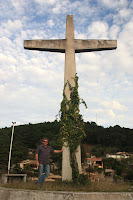
Goodbye Olancho, Choluteca, statue of Jesus

We have now been moved from Juticalpa to Tegucigalpa. We had mixed feelings on this. Whilst Juticalpa had little in terms of restaurants, shops etc, it is a truer example of Honduras countryside than we'll see in Tegus. But, from a social perspective it's got a lot more to offer so it should be a more interesting place for us to live.
Another advantage of Tegus is that we are within easier reach of many areas of Honduras. One weekend we drove to Choluteca which is south, near the Pacific Ocean (though we didn't actually go as far as the coast). It's a lovely town with lots of whitewashed walls and pretty churches. It's also the last main town en route to Nicaragua and a popular stopover point for travellers and trucks heading there. This has led to a strip of fast food outlets which you need to get past in order to see the charm of the town. It's also a very hot part of Honduras, as it's in the plains, surrounded by mountains.


Near Tegus there is the Parque Naciones Unidad El Picacho. This contains a zoo with Honduran animals and a large stone statue of Jesus. It amazes me how so many central and southern American countries either have statues of Jesus or the virgin Mary. The statue is set high on one of the mountains surrounding Tegus so the views are pretty spectacular.


Tuesday, December 29, 2009

Catacamas - caves of the glowing skulls

The next town along from Juticalpa is Catacamas. This is a similar town, though with wider avenues and less congestion. It also is the place of Olancho's main historical site: La Ceuva de Talgua. This is a large cave that goes down to 800 metres underground and has an underwater river (it is known as a living cave as there is wildlife, bats etc. living there). In 1994 the burial cave was discovered by amateur spelunkers. When they shone their torches in the cave they were met by 'glowing' skulls. This is due to the limestone and calcite that covered the bones over the years. Research has shown that they are from about 1000 bc and much older than any previously discovered Honduran remains.


It was interesting to visit and we even got a chance to go into the 'burial' chamber. Most of the remains are in museums in Tegus though so there wasn't much there.

Monday, December 21, 2009

Juticalpa - our new home town

Juticalpa is the capital of Olancha and is two and a half hours from Tegucigalpa. The drive is mountaineous and drops down from the height of Tegus. Juticalpa is surrounded by mountains and this makes it scenic. It's very green and you pass through villages and see trucks on the side of the roads selling fruits etc. You see cows, donkeys and horses but unfortunately also vultures who are eating dead carcasses.

The road is mostly paved, and the last part into Juticalpa is a straight concrete road. The rumour is that this is used at night for small aircraft to land from Nicaragua with drugs which are then transported by land from here. I've since heard that the flights do come, but they land near the villages.


Juticalpa has about 30,000 residents and is a typical grid town with a plaza and church in the middle and roads going out from there. There is a market at the plaza and the odd small stores, restaurants and cafes. There is even a small mall in town, though it's limited in terms of shops. I'll have to wait for my trips to Tegus to do any proper shopping - or visits overseas.
I have yet to find a comprehensive supermarket and it looks like I'll be visiting multiple stores to do the weekly shop. So far we've found one restaurant that serves a little more than tortillas, frijoles and meat - or even chicken and chips. Believe it or not, I am missing salad and vegetables and I can't wait to have a kitchen again so I can prepare food! Or we can buy roasted elote (corn) which you see along the sides of the roads.
I'm enjoying discovering more about Juticalpa and Olancho.


Wednesday, December 9, 2009

arrival in Honduras

After 2 days of travel we're now in Honduras. I flew in on an American Airlines plane and was told by both passengers on the previous plane and this one that Tegucigalpa's airport is one of the most difficult in the world and AA has pilots especially trained and who only do this landing. It seems that the city is surrounded by mountains and the runway is very short. In fact, the pilot on Keith's flight made an announcement to tell people not to worry as there'd be lots of turns in the air and a very fast breaking when they landed. People applauded on the plane once we were down.

We landed fine and I was more concerned about my luggage arriving all the way from Fiji and 3 flights later. Luckily it did and when I went out I was met by a mob of people. The airport is mayhem and of course people came with their whole family to meet passengers. The drive into town is not long but the traffic is a mess. There seem to be way too many cars for some very small roads. In fact, I read in the paper that they are going to start to introduce road tolls for the city to try and address this. I did see that almost every traffic light had people either performing (fire eaters), selling things (mobile phone covers, sweets) or begging for money due to their condition (handicapped, no legs etc).

Tegucigalpa means silver hill in a local native language. It was the area of silver mining for central America in the era of the Spanish occupation. We've been put up at one of the more luxurious hotels in town which is definitely in the 'rich' area. Between that and the mall across the road I've not seen much of Tegucigalpa (Tegus as the locals call it). I have been told that if I do want to go out I must use hotel taxis and not take anyone from the road and to remove all jewelry etc. It seems it's not too safe here, especially for obvious foreigners like myself.

You do see a lot of armed people around. All security has guns and Keith tells me that he has seen 'normal' people with guns in Juticalpa (where we will live). This is in Olancho which is the largest state in Honduras. It's a rural area with mostly cowboys and ranches. It's also where the drugs get smuggled in from Nicaragua and apparently there is a higher proportion of crime there than elsewhere. Lovely.

But, we will make the most of it and follow all the safety tips that we are being given (from the guy on the plane to Digicel staff and hotel employees). Keith has already spent a week in Juticalpa and he was more worried about me being bored than about security.


We went to visit Valle de Angeles and Santa Lucia which are mountain towns surrounding Tegus. Whist they are pretty with cobbled streets and clay tiled roofs they are also very touristy and have many artisan shops and restaurants.